Field Note/Materials
Why Lime
The case for hand-troweled lime in a Connecticut new build.
We use hand-troweled lime on most Chesa walls, traditional and modern alike, in restorations and on new construction in Litchfield County and Greenwich. This note is for the developer, the architect, and the homeowner who has just been told that lime costs more than three coats of paint and wants to know why. The short answer is that lime is the only wall finish that earns depth over time instead of losing it. The longer answer is below, in the order we would explain it on a job walk.
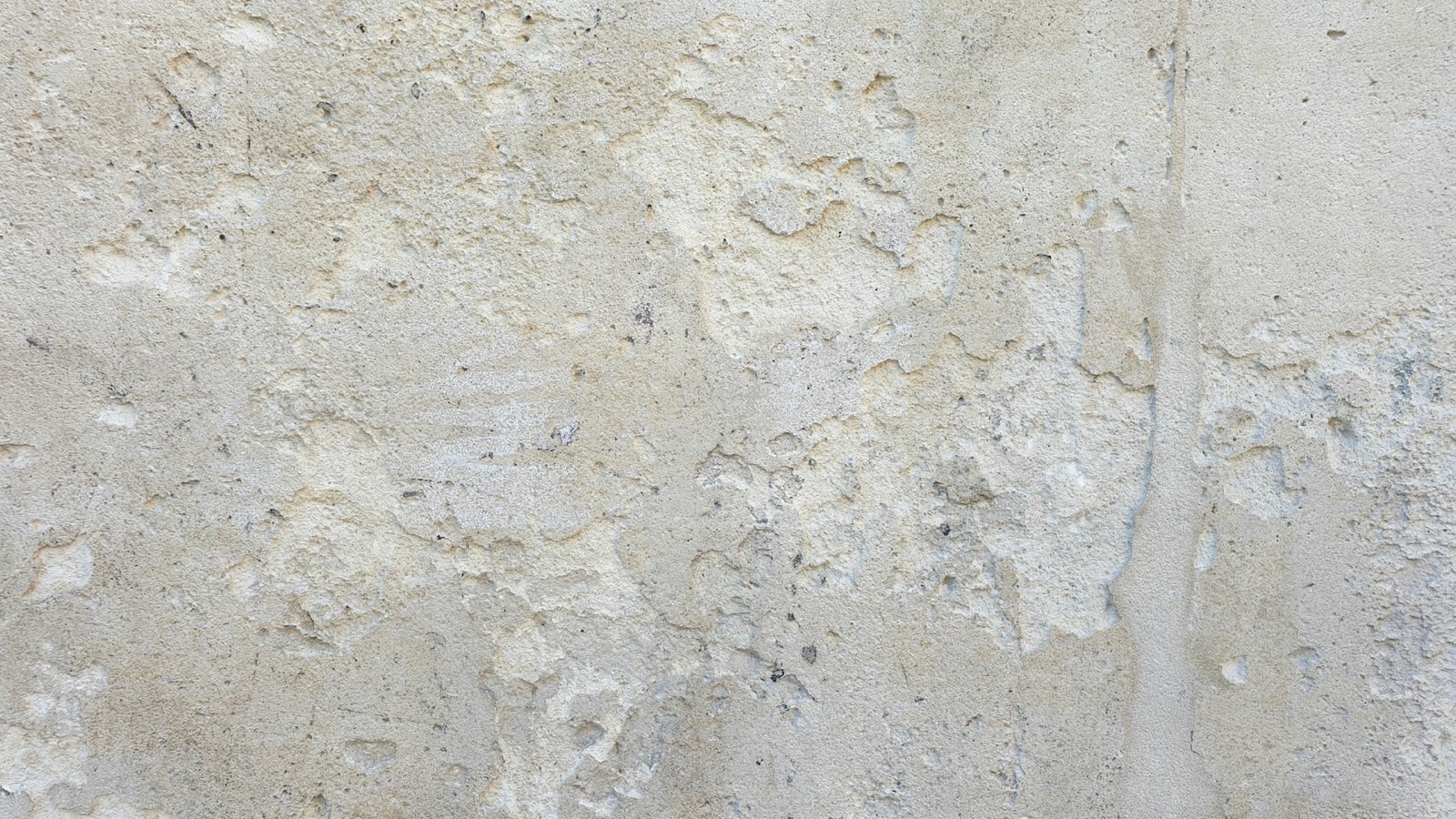
Three coats, three jobs: arriccio, intonaco, velatura
A proper lime wall is built in three layers and each one is doing a different piece of work. The arriccio is the rough leveling coat, troweled hard into a metal lath or directly onto block, sand-heavy and built to lock the wall. The intonaco is the body coat, finer aggregate, worked with a wood float so the surface stays open and breathes. The velatura is the colored lime wash floated on in two or three diluted passes while the intonaco is still drawing moisture, so the pigment sinks into the wall instead of sitting on it. The whole assembly cures for weeks, not hours, and reaches full hardness over the first year. When you run a hand across a finished Chesa wall you are touching the velatura, but you are reading all three coats at once. That is what gives a lime wall its quiet weight.
The Hotel du Couvent precedent: lime-and-hemp on the chamber walls
Festen's work at Hotel du Couvent in Nice is the clearest contemporary case we cite to clients. The bedroom walls there are a lime-and-hemp mix troweled directly over the old monastic masonry, with hemp shiv worked into the body coat for thermal mass and acoustic softness. We use a near-cousin of that mix on Connecticut new builds where the wall assembly is 2x6 framing with mineral wool. The hemp fiber gives the trowel something to bite, it pulls the relative humidity of the room toward stable, and it kills the drum-skin acoustic that you get on a painted drywall room of the same dimensions. A Litchfield bedroom finished this way sounds like a century-old farmhouse bedroom. That is a hard thing to fake.
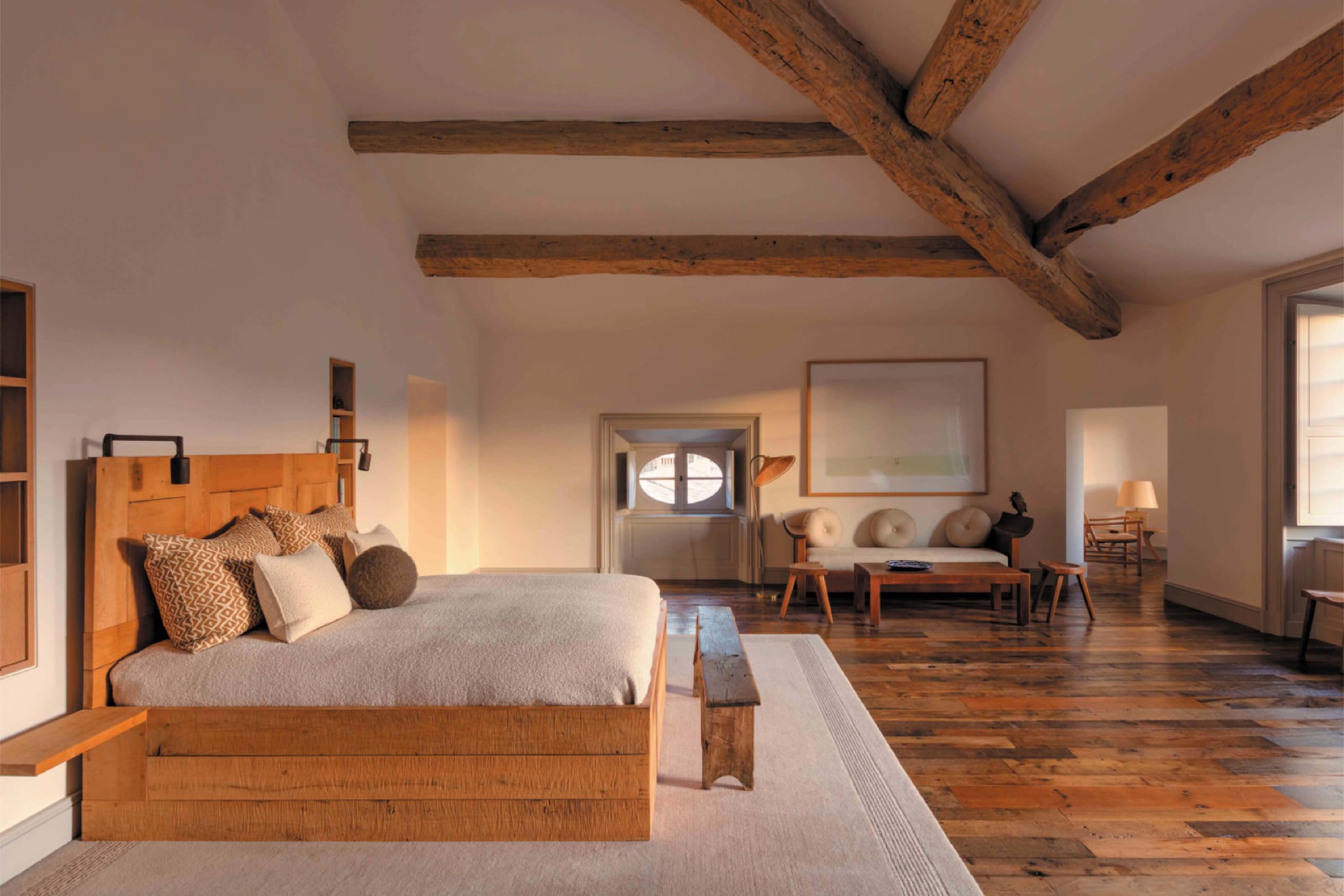
The depth flat paint cannot reach
Paint sits on a wall as a continuous polymer film, which is why a freshly rolled room reads as a slightly plastic surface even when the color is right. Lime cures by drawing carbon dioxide back out of the air, recrystallizing as calcium carbonate inside the wall, so the finished surface is mineral all the way through. Light enters the velatura, scatters between the pigment particles and the lime crystals, and comes back out softened. In a north-facing Connecticut bedroom in February, a Bauwerk velatura in a warm bone reads as candlelit at three in the afternoon. The same room in a premium matte latex reads flat. We have done the side-by-side on a job in Ridgefield with the owners standing in the doorway. They paid for lime in the other six bedrooms before we left the site.
Maintenance: an annual touch-up, not a repaint
Lime forgives. A scuff from a moving blanket, a child's handprint along a stair wall, a leak that left a halo behind a radiator: each of these is a sponge, a small batch of matched velatura, and ten minutes with a soft brush. The patch sinks into the surrounding wall within a week as the new lime carbonates and matches the cure of the old. We hand every Chesa client a labeled jar of the original velatura mix at closeout, with the date and the batch number, and we keep a duplicate in the studio archive. On a ten-year-old Chesa house in Salisbury we have repainted nothing. We have touched up four walls. The rest of the lime is doing what it should: slowly warming from bone toward ivory as it ages.
The makers we specify by name
The bag of lime matters as much as the trowel. Kerakoll Biocalce out of Modena is our default body coat in Connecticut: clean grading, predictable set, certified for interior breathable wall assemblies. Tassin from the Rhone valley is what we use when we want a longer working time on a large room. Saint-Astier from the Dordogne is the natural hydraulic lime we specify on exterior renders and on any stone wall that still needs to move. Bauwerk out of western Australia, by way of Belgium, makes the pigmented limewashes we use for the velatura coat: their pigments are mineral, their dilution rates are honest, and their color archive lets us match a room three years later. Kalklitir from Iceland is our reach for the cooler grays and the silvered whites that suit an east-facing Connecticut sunroom. We specify these by name on the drawings, on the spec, and on the schedule. The substitution clause reads: no substitutions without studio approval. We mean it.
How to bring lime into your project
If you are restoring an existing house, we walk the walls with you, identify what was originally lime under later layers of latex, and plan the order of strip-back. If you are building new in Connecticut or the Hudson Valley, we write lime into the wall assembly at framing, not at finish, so the substrate is ready to receive it. Either way, the conversation starts with a site visit and a sample board mixed for your light. Call the studio at (203) 651-8649 and we will set the visit. The boards stay on the wall for two weeks before any color is locked in. Lime is a slow material. The decisions around it deserve the same pace.

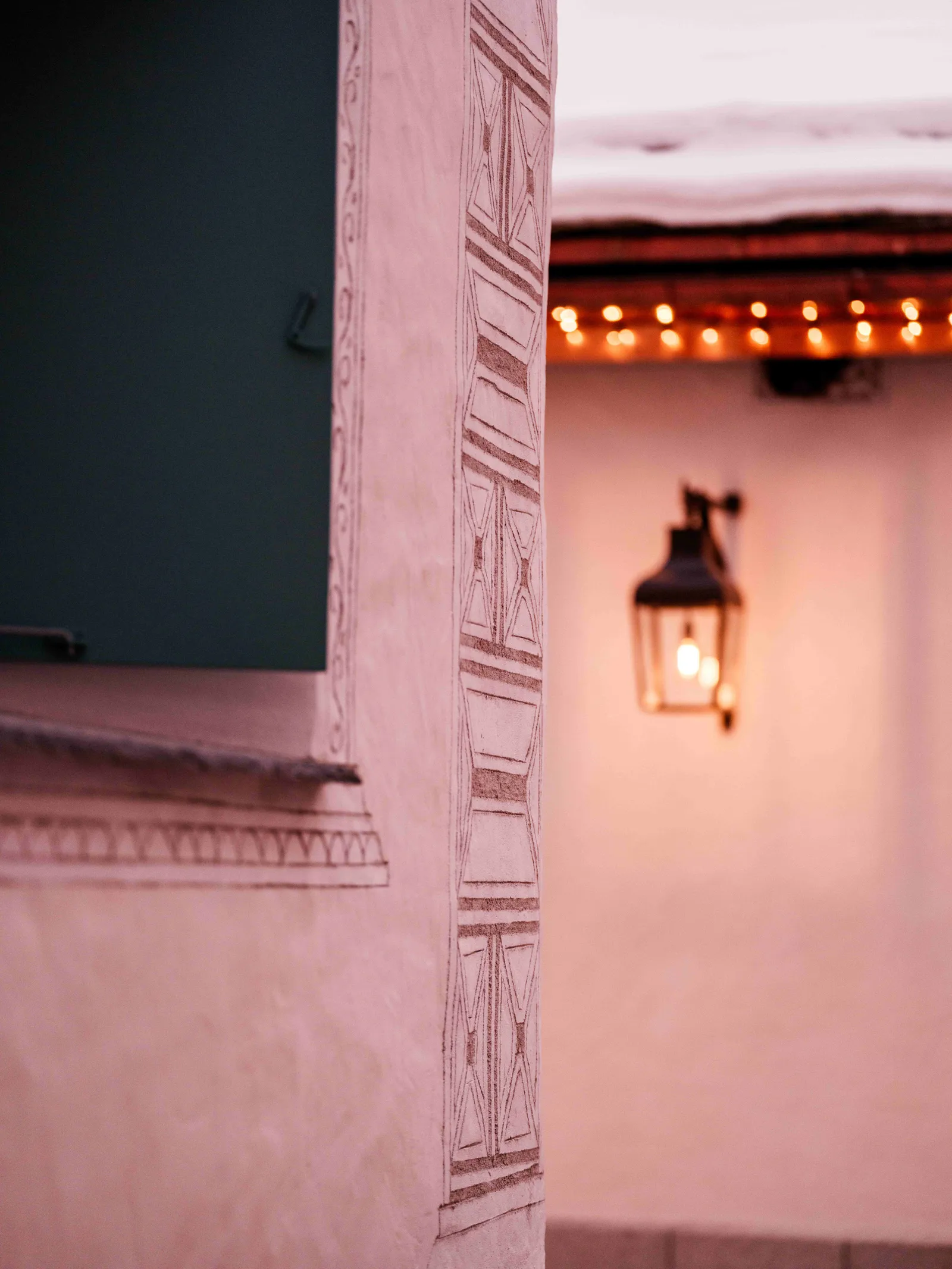
Lime against painted timber
Painted alpine timber set against a warm bone velatura. The lime carries the room while the timber holds the geometry.
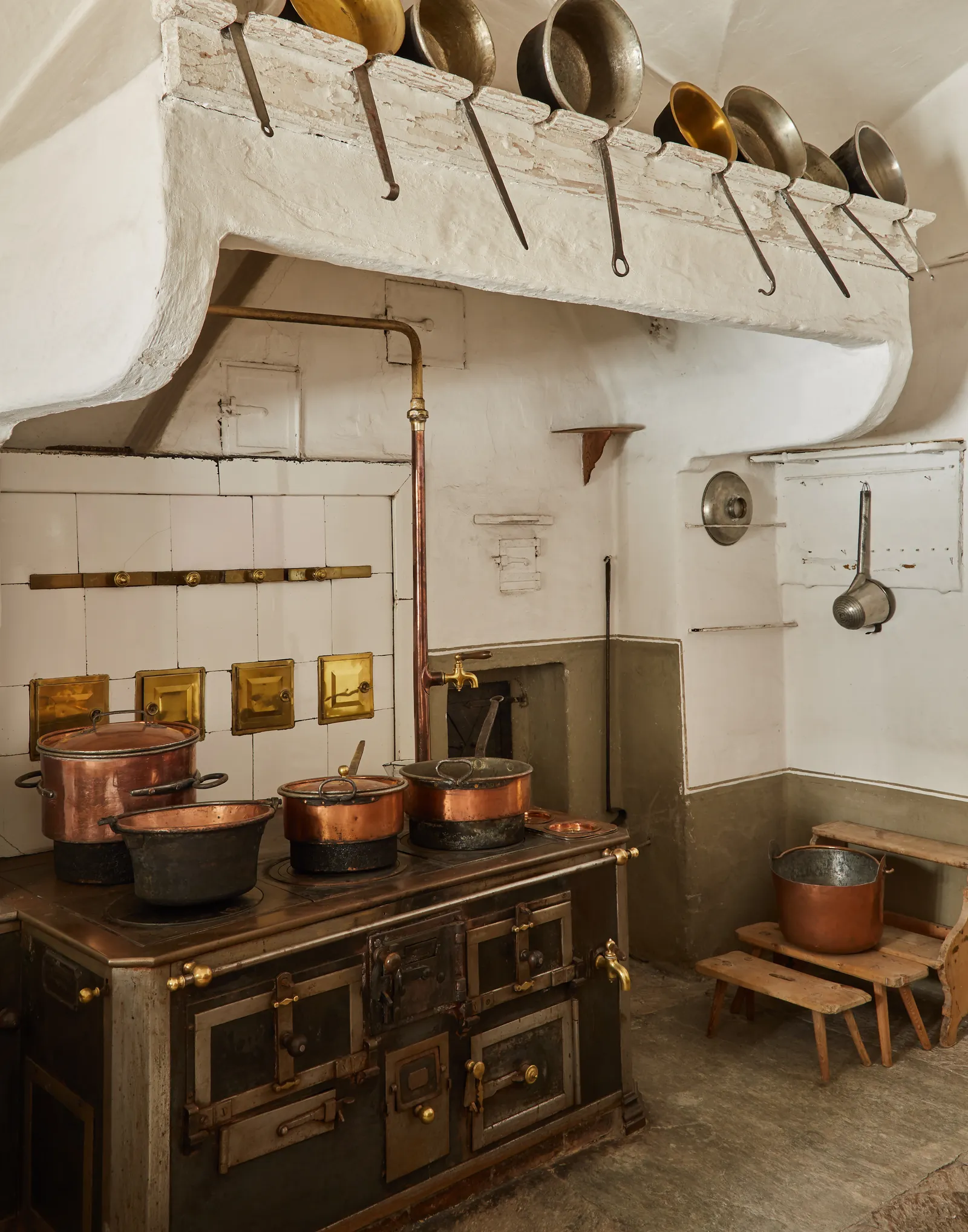
Ten years on, still working
A wall finished in 2014, photographed in 2024. Four small touch-ups over the decade. The rest is the velatura slowly warming from bone toward ivory, the way good lime should.
Sources and notes
Festen Architecture, Hotel du Couvent, Nice (lime-and-hemp chamber walls).
Kerakoll Biocalce technical data sheets, Modena.
Saint-Astier natural hydraulic lime, Dordogne.
Bauwerk Colour pigmented limewash archive.
Tassin chaux aerienne, Rhone valley.
Kalklitir limewash, Iceland.
Chesa Studio job archive: ten-year aging studies on Litchfield County walls.
Discuss a lime spec for your project.
Send a brief or call the studio. We respond to every serious inquiry within two working days.